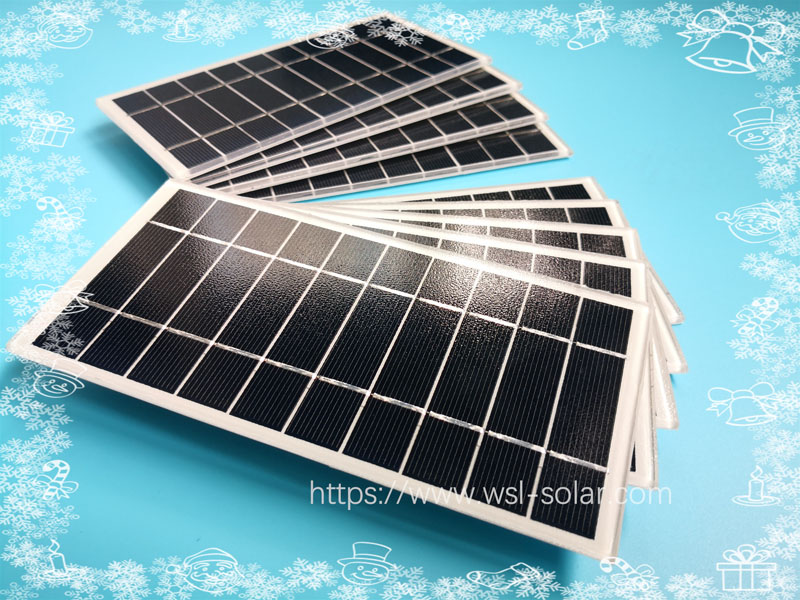
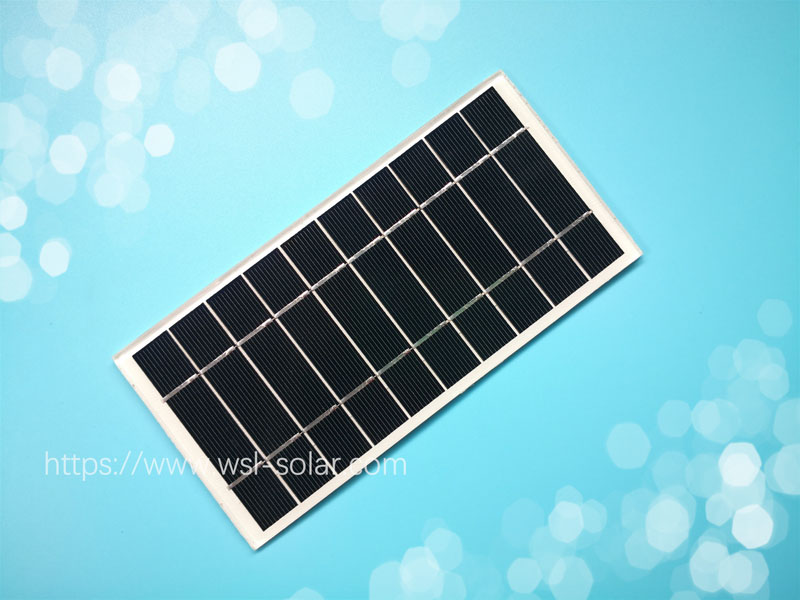
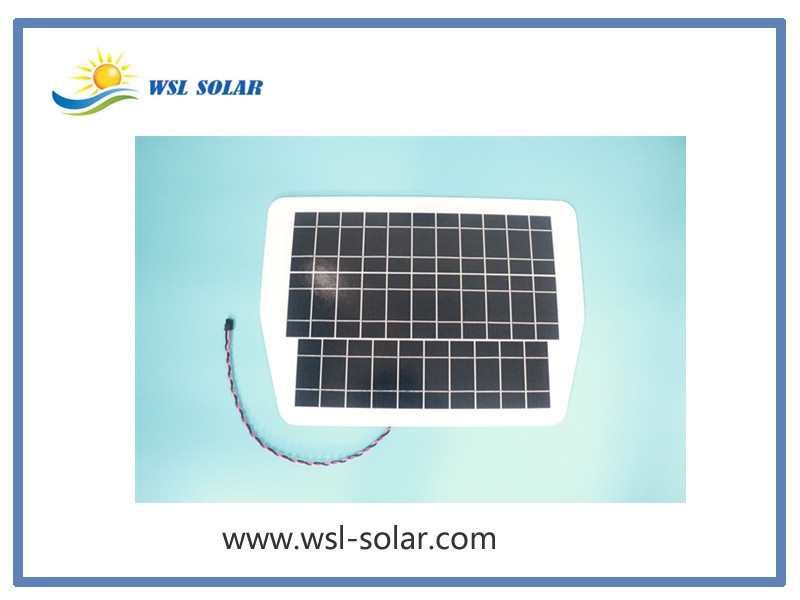
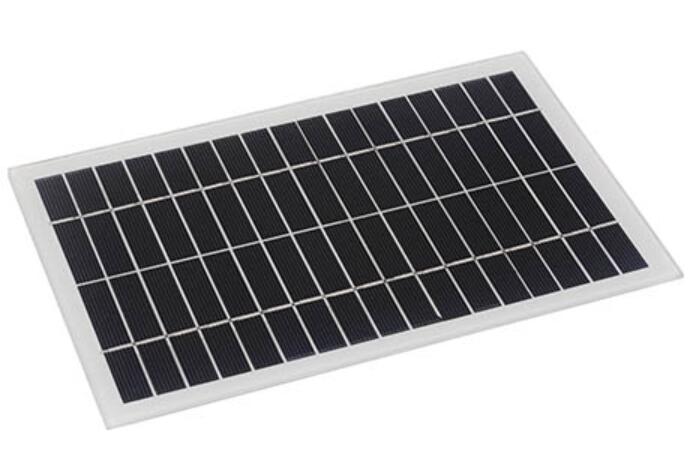
Custom Solar Panels have several basic parameters, rated power (Pmax), efficiency (η), open circuit voltage (Voc), short circuit current (Isc), peak voltage (Vmpp), and peak current (Impp).
Rated power (Pmax): indicates the power generated by the maximum power point voltage when the custom solar panel is at the standard ambient temperature (STC, ie, the atmospheric mass is 1.5, ambient temperature is 25 ° C, the light radiation intensity is 1000 W/m 2 );
Efficiency (η): represents the photoelectric conversion efficiency of the silicon wafer inside the custom solar panel, such as an efficiency of 16.5%, which means that the silicon wafer can generate 165 W of electricity per square meter;
Open circuit voltage (Voc): indicates the voltage across the positive and negative terminals (custom solar panel’s no-load voltage) when the solar panel is open at standard ambient temperature;
Short-circuit current (Isc): indicates the short-circuit current generated by short-circuit between the positive and negative terminals of the solar panel when the panel is at the standard ambient temperature;
Peak voltage (Vmpp): indicates the operating voltage of the customized solar panel at the maximum power point (the highest voltage in strong light) when the panel is at the standard ambient temperature;
Peak current (Impp): Indicates the operating current corresponding to the operating voltage of the solar panel at the maximum power point when the panel is at the standard ambient temperature.
Author: Carrie Wong
From WSL Solar Co., Ltd.
WSL Solar has been a quality and professional manufacturer of custom solar panel and solar solution provider in China since 2006.
Recently, Jinko has frequently moved, and international solar module orders have been continuously updated. At the same time, it has also raised its 2020 performance forecast.
According to incomplete statistics, JinkoSolar’s international solar photovoltaic module orders opened in 2020 only reached 1.2GW.
Judging from the recent international orders signed, including Sri Lanka and Hungary, JinkoSolar supplies 400W high-efficiency Cheetah solar panels for Sri Lanka roof projects and 13.6MW modules for 19 photovoltaic power stations in Hungary.
The announcement revealed that JinkoSolar provided 2MW high-efficiency Cheetah series solar panels to Jacksons Power and Energy in Sri Lanka, which is currently one of the country’s largest rooftop photovoltaic systems. Compared with traditional single-sided solar panels, Cheetah’s 158.75-size half-cell cell design enables industrial and commercial rooftop photovoltaic systems to provide higher power, efficiency, and less shadow blocking effects, increasing the power generation by 15% in the same area.
In Hungary, JinkoSolar supplied 13.6MW of solar modules to Photon Energy Solutions HU Kft (“Photon Energy”) for installation in three Hungary projects. These projects consist of 19 photovoltaic power plants, located in Tisa Kecske, Hungary, Ormászf it, and Nagyécéd, Hungary. It is understood that the total annual power generation of the above power stations is expected to be 16GWh.
In addition, JinkoSolar recently provided 1GW of high-efficiency photovoltaic solar panels to photovoltaic power stations in Colombia, Mexico and Spain.
In fact, most of the orders for photovoltaic module companies in 2020 have been signed in the second half of 2019, and JinkoSolar’s public orders are actually only part of the signed orders.
People in the photovoltaic industry will not be unfamiliar with Jinko Energy. JinkoSolar Holdings Limited (NYSE: JKS) is a ground company in China, the United States, Japan, Germany, the United Kingdom, Chile, South Africa, India, Mexico, Brazil, the UAE, Italy, Spain, France, Belgium and other regions. Solar power products, solutions and technical services are provided by power station, commercial and civil customers.
It is worth mentioning that JinkoSolar recently raised its forecast for the fourth quarter and full year of 2019.
JinkoSolar predicts that total solar PV module shipments in the fourth quarter of 2019 will reach 4.5GW-4.6GW, with total revenue of US $ 1.35 billion-US $ 1.38 billion, respectively, a 6% increase from previous estimates, 14%. In terms of gross profit margin, JinkoSolar is expected to reach 18% -20% in the fourth quarter of 2019, and the previous guidance price was 18.5% -20.5%.
For the full year of 2019, JinkoSolar will increase its total solar PV module shipments to 14.3-14.44GW.
Looking forward to 2020, JinkoSolar estimates that this year’s module shipment will be about 18GW-20GW, which is about 4GW-6GW higher than the full-year forecast for 2019, which means that total PV module shipments will increase by 35%.
It should be noted that since 2016, JinkoSolar has firmly occupied the leading position in global photovoltaic module shipments.
According to statistics, JinkoSolar continues to be the leader in photovoltaic modules in 2019, and Jinko’s module shipments in 2019 are 14.3-14.44GW, which is 37.86% higher than the second place. This is the fourth consecutive year that JinkoSolar has occupied the largest shipments since 2016.
JinkoSolar has established a vertically integrated photovoltaic industry chain. As of December 31, 2019, monolithic wafer capacity was 11.5 GW, solar cell capacity was 10.6 GW, and solar module capacity was 16GW. JinkoSolar has 7 production bases worldwide, 15 overseas subsidiaries, and more than 15,000 employees.
Editor: Carrie Wong / WSL Solar
WSL Solar has been a quality and professional manufacturer of custom solar panel and solar solution provider in China since 2006.
With the rise of global green energy, the development of the rooftop photovoltaic market has become a general trend. Whether domestic or overseas, this market is being deployed one after another.
Earlier this year, Tesla CEO Elon Musk stated that the company will prepare to launch solar roof business in other international markets outside the United States in 2020, including China.
Tesla’s layout of its solar roof business dates back to 2008.
In October 2008, Tesla founder Elon Musk’s cousins Lyndon Rive and Peter Rive founded SolarCity, a family photovoltaic installation company with a cumulative installed capacity of more than 3GW. It was once the largest domestic solar photovoltaic system service provider in the United States.
In December 2012, SolarCity went public on the Nasdaq and acquired Silevo in 2014, extending from photovoltaic installation services to the manufacturing of battery modules.
In June 2016, Tesla purchased SolarCity under its $ 2.6 billion stock, but SolarCity was in a dilemma when it was acquired. In the following years, its business plummeted and it suffered annual losses.Musk was also accused by Tesla shareholders and To sue.
In October 2019, Tesla launched its third-generation photovoltaic roof product (Solar Roof V3). Due to the use of Chinese photovoltaic cells, the price is 40% lower than in the past.
In December 2019, Musk stated on Tesla’s earnings call that Tesla’s photovoltaic and energy storage business will grow faster than its electric vehicle business, and Tesla will focus more on Tesla Pull on the energy business.
According to the company’s latest developments, Tesla is looking for “business and residential user-side” business development managers, project development engineering managers and other related talents. The monthly salary for the position of business development manager is 30,000 to 40,000 yuan, that is, the highest annual salary can be Up to 480,000 yuan. It is enough to see Tesla’s determination to revive the solar roof photovoltaic business.
In fact, Tesla’s development of photovoltaics in China is inseparable from Chinese products and technologies. In the final analysis, Tesla’s main profit model is to improve Tesla’s new energy electric vehicle charging needs, and use solar photovoltaic power generation as a new investment profit growth point.
The industry’s analysis of Tesla’s business model found that the company made profits through investment in photovoltaic power plants, so Tesla’s benchmarking company was photovoltaic power plant development investment and operating companies.
It is unclear whether Tesla’s BIPV business in China will replicate the US model.
Back in the domestic market, companies’ investment in rooftop photovoltaics is also in full swing.
Since the fourth quarter of 2019, Jinko has launched its N-type all-black module, which is specifically targeted at the residential roofing market. It has a 405-watt residential version with an efficiency of 21.22%. The launch of this product means that The company will vigorously expand its photovoltaic home roof business in 2020 in Europe, Japan, Australia, Southeast Asia and China.
On January 4, 2020, Ganneng announced that Jiangxi Yuchen Smart Energy Co., Ltd., a subsidiary of the company, plans to build a 16MWp rooftop photovoltaic power generation project in the Oufei Light Park in the high-tech zone of Nanchang, Jiangxi Province. The total planned investment of the project is about 5,400. It is planned to be connected to the grid for power generation in the first half of 2020.
On March 4, 2020, Jinlang Technology and Wal-Mart jointly created an urban green photovoltaic roof, aiming to achieve the 2025 emission reduction target and promote the harmonious symbiosis of industry development and the natural environment.
In fact, from 2013 to 2020, just 7 years after the Chinese household photovoltaic market was subsidized by the government, the Chinese household photovoltaic market set off an ups and downs for the whole nation.
Since the “531 Policy”, whether for active or passive reasons, in order to promote the further reduction of photovoltaic power generation costs, Chinese photovoltaic companies are getting rid of the risk of a single market and actively deploying the rooftop photovoltaic market.
According to the industry, the early pain points of rooftop photovoltaic include sub charging, high power with low power, exaggerated publicity, and making quick money in the business process. There is no shortage of short-term speculation in the industry, no long-term planning, and even zero investment in maintenance after installation. What’s more, some brand advertisements promise a 20-year guarantee, but in fact they haven’t done operation and maintenance work and can’t guarantee quality at all.
As photovoltaic power generation enters millions of households, the competition on rooftop photovoltaics will shift from simply competing for rooftop resources to a high-quality, high-security, high-tech competition model with efficient technology as its core competence.
In the future, rooftop photovoltaics will enter the era of efficient technology and personalized customization.
In terms of system design, Chinese companies are also exploring and innovating. They have conducted in-depth research in the areas of rapid assembly, saving materials, and reducing assembly labor costs in order to have multiple advantages.
In the future, the focus of photovoltaic research and development will also focus on photovoltaic materials to high-efficiency cells, high-efficiency components, and customized system integration design. Think about how to integrate excellent technology and equipment to share the huge “cake” of the rooftop photovoltaic market. “.
Editor: Carrie Wong / WSL Solar
WSL Solar has been a quality and professional manufacturer of custom solar panel and solar solution provider in China since 2006.
A few days ago, Wang Bohua, secretary general of the China Photovoltaic Industry Association, provided data that from January to October 2019, China’s photovoltaic product exports reached a new high.
According to statistics, the total export of silicon wafers, solar cells and solar panels reached US $ 17.74 billion, a year-on-year increase of 32.3%. Among them, the high-tech midstream photovoltaic products’ solar cell exports in the first half of this year have exceeded the whole of 2018; downstream solar panel exports have exceeded the whole of 2018 in the first eight months of this year.
Not only that, Wang Bohua said that based on the substantial increase in export value, the diversification trend of China’s solar photovoltaic exports has also become stronger. At present, there are 26 countries and regions with exports exceeding US $ 100 million, and 13 countries with exports exceeding 1 GW.
China plans to accomplish a 200-tonne megawatt-level space-based solar power station by 2035, according to the China Academy of Space Technology.
The space-based solar power station would capture the sun’s energy that never makes it to the planet, said Wang Li, a CAST research fellow with the program, when attending the sixth China-Russia Engineering Forum held last week in Xiamen, southeast China’s Fujian Province.
The energy is converted to microwaves or lasers and then beamed wirelessly back to the Earth’s surface for human consumption, Wang said.
“We hope to strengthen international cooperation and make scientific and technological breakthroughs so that humankind can achieve the dream of limitless clean energy at an early date,” Wang said.
Compared with traditional fossil energy, which has been increasingly exhausted and is responsible for severe environmental issues, space-based solar power is more efficient and sustainable, providing a reliable power supply solution for satellites and disaster-hit areas or isolated areas on the Earth, Wang said.
The concept of collecting solar power in space was popularized by science fiction author Isaac Asimov in 1941. In 1968, Peter Glaser, an American aerospace engineer, wrote a formal proposal for a solar-based system in space.
China has proposed various sunlight collecting solutions and made a number of major breakthroughs in wireless energy transmission since the country listed space-based solar power as a key research program in 2008.
However, ambition has long been a challenge for current technology because it involves the launch and installation of numerous solar panel modules and the efficient wireless transmission of mega energy.
With an investment of 200 million yuan ($28.4 million), China is building a testing base in Bishan, southwest China’s Chongqing Municipality, for the research of high-power wireless energy transmission and its impact on the environment.
Researches in this field will spur the country’s space science and innovation in emerging industries like commercial space transportations, Wang said.
Source from ChinaDaily
*** About WSL Solar *** WSL Solar has been a quality and professional manufacturer of custom solar panels and solar solution provider in China since 2006. https://www.wsl-solar.com/
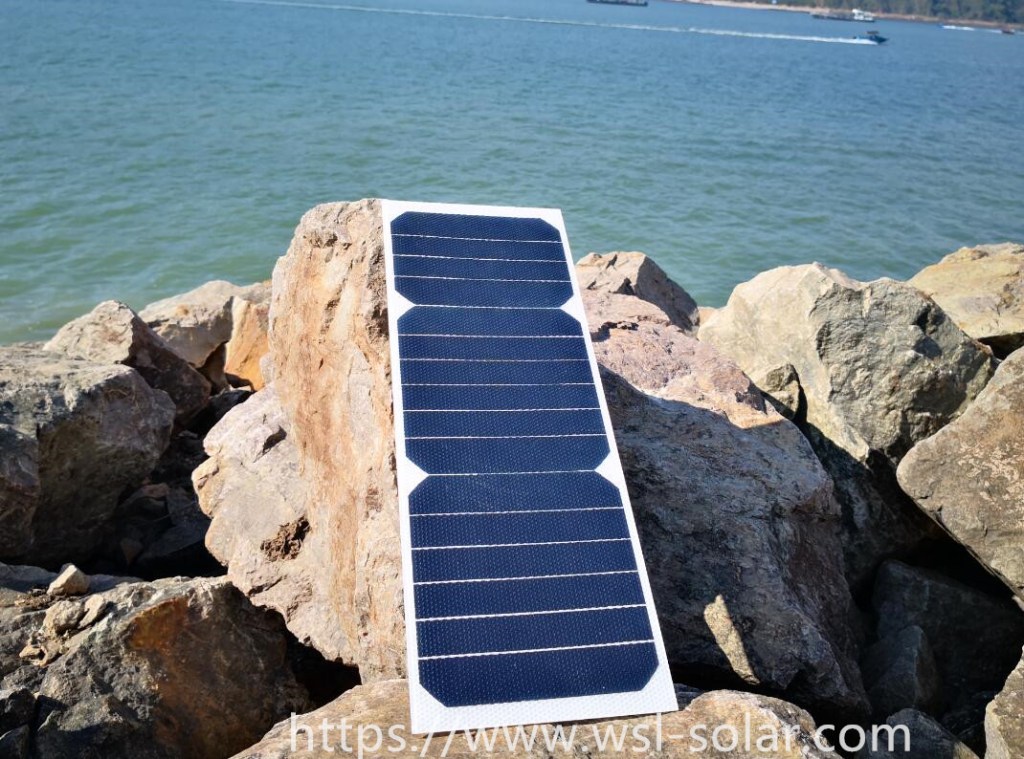
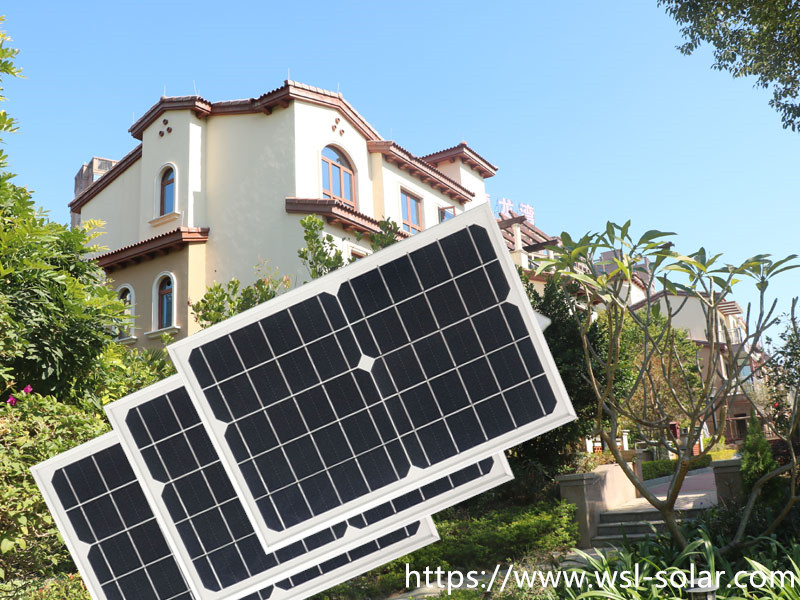
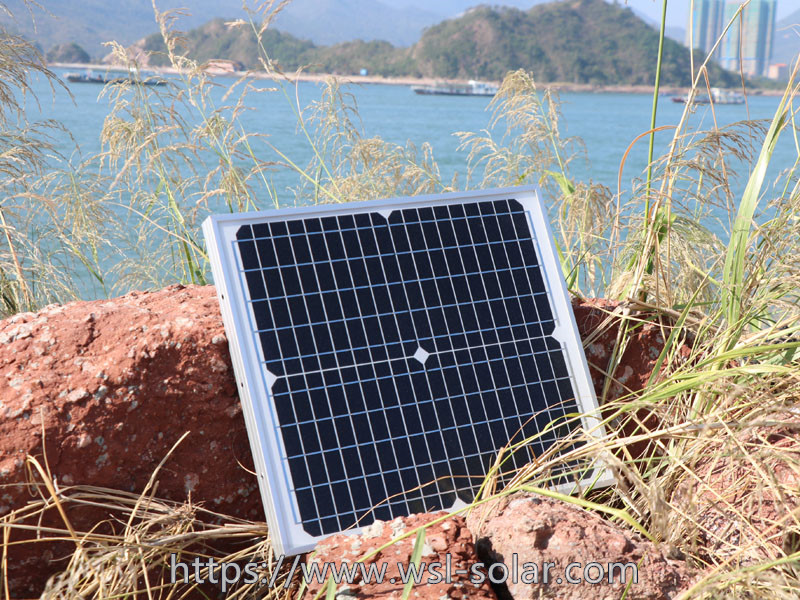
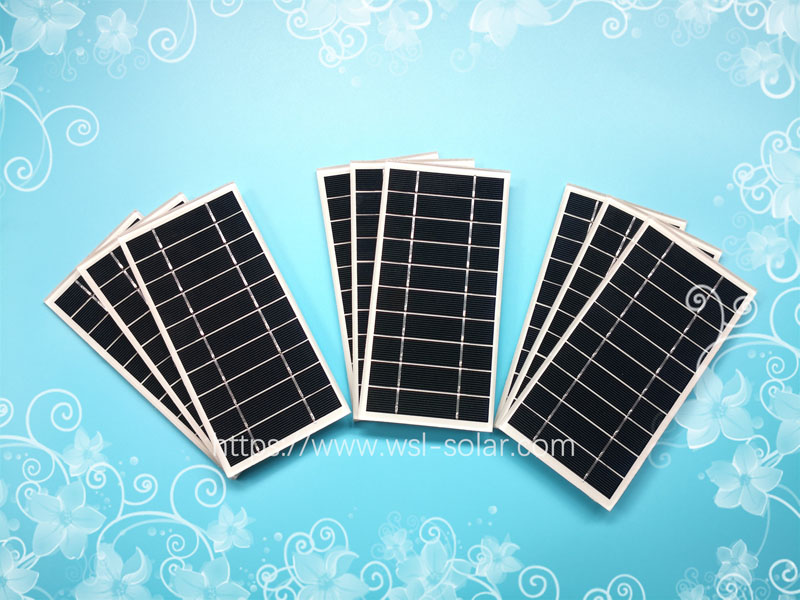
A solar panel is a device that converts solar energy into electrical energy. Since solar panels can be customized flexibly, small custom solar panels have been applied to many off-grid solar applications, such as solar chargers, solar attic fans, and solar LED lights etc.
Usually
the solar panels we see are a complete piece of panel, but do you know what the
internal structure of the solar panels is?
Here,
we mainly introduce the crystal silicon solar panels that are more common on
the market as an example.
The
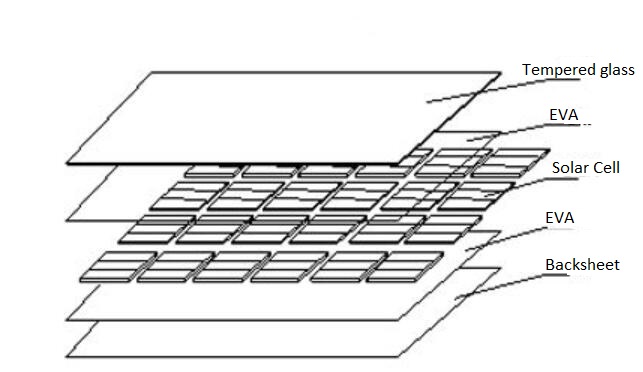
structure of crystalline silicon solar panels is usually: tempered glass / EVA
/ solar cell / EVA / backsheet.
Solar Panel Construction
(1) Tempered glass: Its function is to protect the main body of power generation (such as solar cells). The choice of light transmission is required:
1. The light transmittance must be high (generally 91% or more); 2. Ultra-white tempering treatment.
(2) EVA: Used to
bond fixed tempered glass and solar cell. The quality of transparent EVA
material directly affects the life of solar panels. EVA exposed to air is prone
to aging and yellowing, thus affecting the light transmission of solar panels,
so then, affecting the power generation quality of the solar panels. In
addition to the quality of the EVA itself, the influence of the lamination
process of the custom solar
panel manufacturers is also very large. For example, if the EVA
adhesiveness is not up to standard, the bonding strength of EVA and tempered
glass and backing plate is insufficient, which will cause EVA early aging, thus
affects solar panel’s life.
(3) Solar Cell: Solar
cells are the core components of solar panels. The main function of solar cell
is power generation.
(4) Back sheet: Its function is sealed,
insulated and waterproof. Generally, materials such as TPT and TPE must be
resistant to aging. Most solar panel manufacturers are guaranteed for 25 years.
Tempered glass and aluminum alloys are generally no problem. The key is whether
the back sheet and silica gel can meet the requirements.
When the
solar cell is soldered, the next step is to laminate, according to the
following sequence, tempered glass / EVA / solar cell / EVA / back plate,
stacked, and then sent to the laminator for vacuuming, and high temperature
lamination. EVA is solid at room temperature, but when EVA is exposed to high
temperatures, it becomes liquid. Therefore, in the laminator, after the EVA is
melted into a liquid state, the solar cell sheet and the tempered glass and the
back sheet are glued together.
Just after laminating from the laminator, usually on the four sides of the solar panel, there is some excess EVA overflow, which requires a knife to cut and burr. After processing, a complete solar panel is produced.