What is Household Photovoltaics?

In recent years, with the improvement of people’s environmental awareness and the deepening of energy reform, coupled with the reduction of industrial chain costs and the rise of various household station construction models, more and more families have begun to consider installing photovoltaic power generation systems on their roofs. According to data from the National Energy Administration, as of the end of March 2024, China’s total household photovoltaic installed capacity will be 122.94GW. The cumulative number of installed households has exceeded 5 million.

Although household photovoltaic installations have grown rapidly in the past two years, overall, the penetration rate of household photovoltaic market is still low. According to data from Sepu Consulting, the penetration rate of household photovoltaics in 2023 is only 8%, which means that there are at least 60 million roofs to be developed. There are still many people who do not know enough about rooftop photovoltaics or have misunderstandings. Today, let’s talk about household photovoltaics.
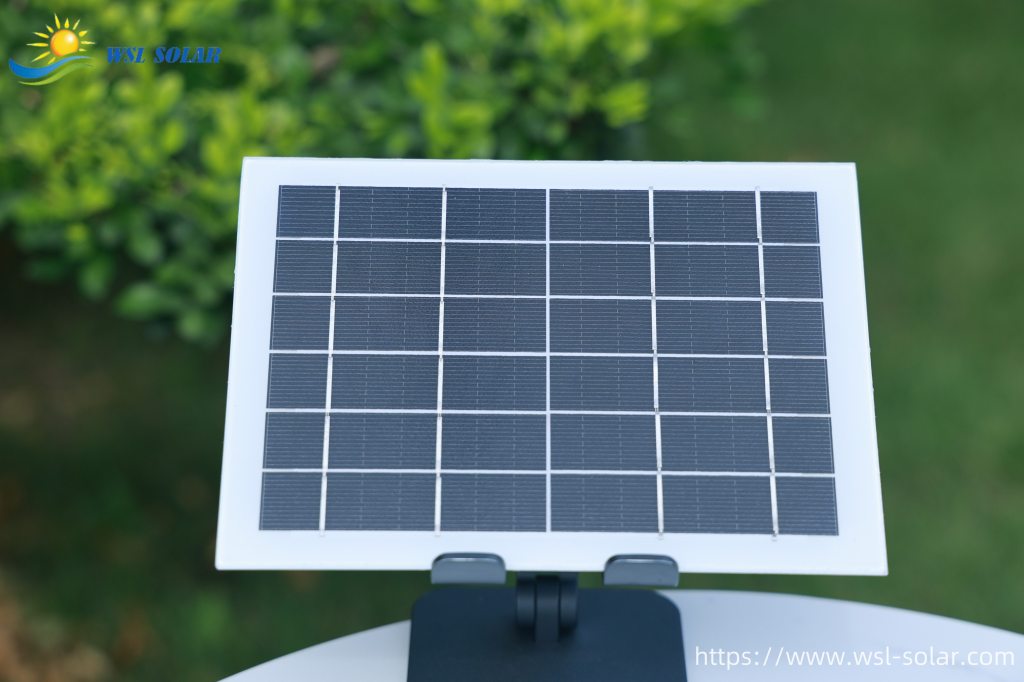
1. What is household photovoltaics?
Household photovoltaic is a type of distributed photovoltaic, that is, by installing solar photovoltaic panels on the roof or courtyard of the house, solar energy is converted into electricity for household use, and the excess electricity is sold to the grid (self-generation and self-use, surplus electricity is connected to the grid), or the generated electricity is directly sold to the grid in full to obtain electricity fee income (full access to the grid).

2. What are the benefits of household photovoltaic?
Economic benefits: By installing household photovoltaic systems, families can use solar energy to generate electricity, reduce dependence on grid electricity, and thus reduce electricity bills. Excess electricity can also be sold to the grid for additional income.

Environmental protection and energy saving: Photovoltaic power generation is a clean energy that does not produce pollutants such as carbon dioxide. It helps to reduce carbon footprint, protect the earth’s home, do a little to slow down global warming, and leave a safer and more livable home for future generations.

Increase the utilization rate of roofs/courtyards: Roofs and courtyards usually have large vacant areas. Installing photovoltaic panels can make full use of these spaces, and increase the value per unit area without affecting normal use, that is, increase the utilization rate.

Energy independence: Photovoltaic systems enable families to achieve energy independence to a certain extent, especially in areas with unstable power supply or high electricity prices. Improving the safety and stability of electricity is of great significance to improving people’s lives.

Beautiful: Modern photovoltaic panels are beautifully designed and can be perfectly integrated with the roof to enhance the appearance of the house.

3. Precautions for installing household photovoltaics
Before deciding to install a household photovoltaic system, you need to pay attention to the following aspects:

Roof conditions: Make sure the roof structure is stable, has enough space and a good orientation, and is not blocked by trees or other buildings.

System design: According to the family’s electricity demand and roof conditions, choose the appropriate photovoltaic module array and inverter to ensure the best performance of the system.

Policy support: Understand the local power grid’s open capacity, grid connection requirements and power companies’ photovoltaic grid-connected electricity prices, etc. These policies may affect the return on investment and the benefits obtained.

Professional installation: Choose a qualified and experienced installation company to ensure the quality and safety of the system installation and avoid later maintenance and safety hazards.

4. Answers to common problems
Many families may encounter some problems during the installation and use of photovoltaic systems. The following are common problems and their answers:

1)How long is the life of a photovoltaic system?
Generally speaking, the service life of a photovoltaic panel is about 25 years, while the life of an inverter is 10 to 25 years. Regular maintenance and care can extend the service life of the system.

2)Can the photovoltaic system still generate electricity on cloudy or rainy days?
Although the power generation efficiency of the photovoltaic system will decrease on cloudy or rainy days, it can still generate a certain amount of electricity. Therefore, this situation is usually taken into account when designing the system to ensure the stability of power supply throughout the year.

In addition, some new solar cell technologies can even generate electricity at night or on rainy days. These technologies generate electricity by storing the energy of visible and near-infrared light that is not absorbed and releasing this energy at the appropriate time.

3)How much does it cost to install a photovoltaic system?
The installation cost depends on the size of the system and the choice of components. Generally speaking, the initial investment is large, and the payback period is usually around 5 to 10 years, which varies depending on the region and the system design. For details, please consult the relevant power station construction companies.

4) Is it difficult to maintain the photovoltaic system?
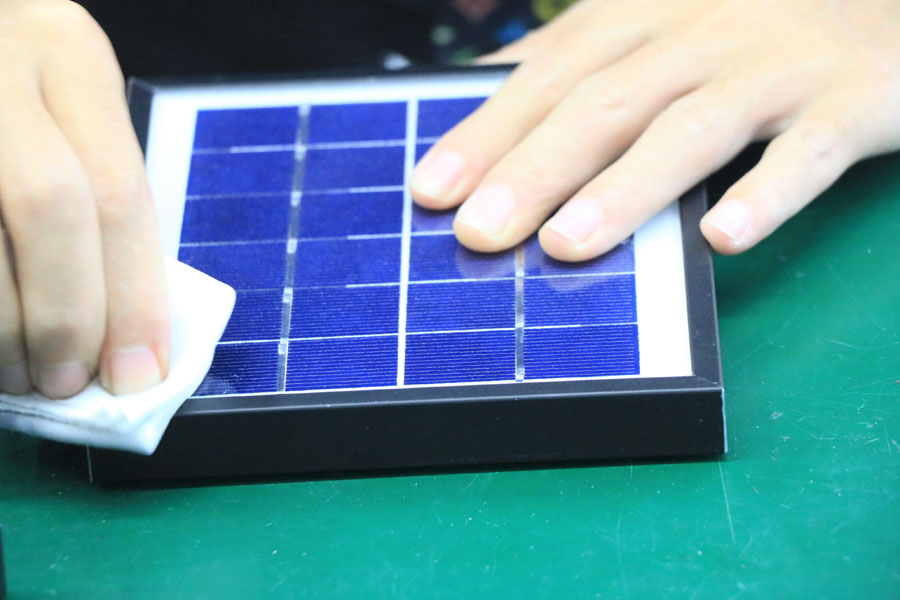
The maintenance of the photovoltaic system is relatively simple but highly professional. The daily work mainly involves regular cleaning of photovoltaic panels, checking the operating status of the system and handling faults. Most installation companies will provide a certain period of warranty and after-sales service.

5) Is there a radiation problem with photovoltaic power stations?
Radiation can be divided into two types: ionizing radiation and non-ionizing radiation, and ionizing radiation is harmful to the human body. Photovoltaic power generation is non-ionizing radiation. Photovoltaic power generation mainly converts solar energy into electrical energy. Compared with daily household appliances, the radiation of the photovoltaic system is negligible, so it can be installed and used with confidence.

In general, installing a photovoltaic power station on the roof not only helps save electricity bills and protect the environment, but also improves asset utilization, and has become a new “green fashion”. However, before installation, it is very necessary to fully understand the characteristics of the photovoltaic system and related precautions to ensure long-term and stable returns.

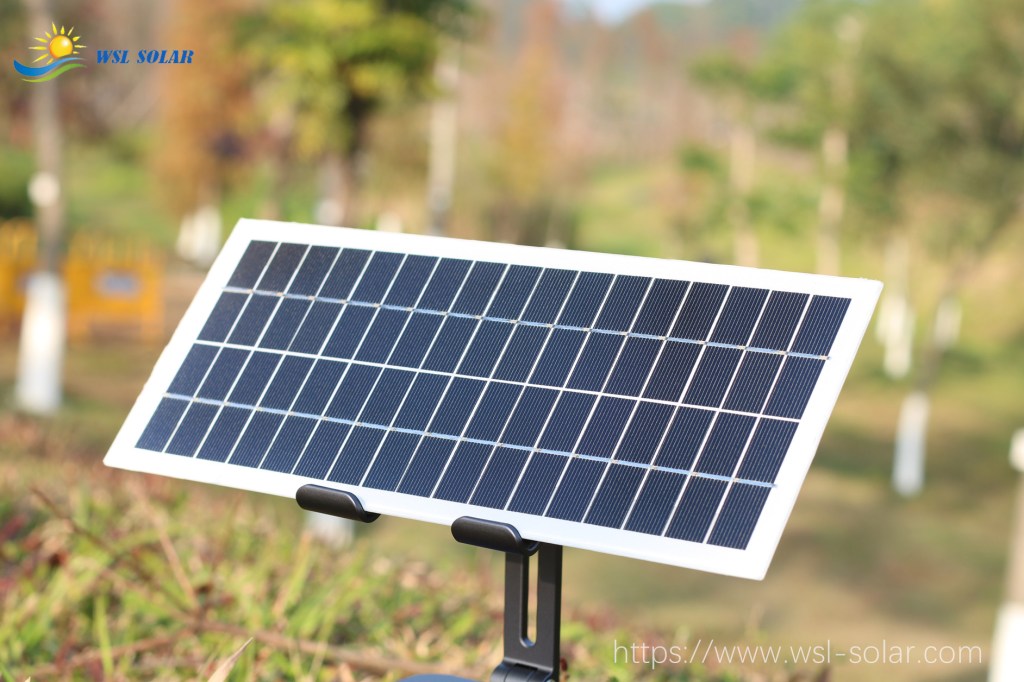
WSL Solar has been a quality and professional manufacturer of custom solar panels, solar mini panels, IoT solar panels and solar solution provider in China since 2006.
https://www.wsl-solar.com

Custom Solar Panel Manufacturer – WSL Solar

Thank you, my dear customers, for your continued support and recognition of WSL Solar’s products and services. Your satisfaction is our driving force to continue delivering high-quality custom solar panels and solar solutions . We take pride in being a professional and reliable solar solution provider in China since 2006.

https://www.wsl-solar.com

Tips to Choose the Right Solar Panel for Your Battery

Are you looking for the right solar panel to charge your battery? Here are some tips to help you choose the right one.

When selecting a solar panel to charge your battery, it is essential to ensure that the voltage of the solar panel is greater than the fully charged voltage of the battery by 20-30%. For instance, a 6V battery requires an 8-9V solar panel, and a 12V battery requires a 15-18V solar panel.

Custom Solar Panel - Findy Solar 2024.jpg

Another crucial factor to consider is the solar panel’s Voltage Open Circuit (VOC), which should be between 1.4 and 1.8 times the nominal battery bank voltage. Suppose you have a 24-volt system, in that case, the VOC should be between 33.6V and 43.2 volts.

In addition to voltage, also consider the amperage of the solar cell. The amperage will fluctuate with sun exposure and determine how long it takes to recharge the battery. By keeping these factors in mind, you can choose the perfect solar panel to power your battery.

Choosing the right solar panel for your battery is crucial to ensure optimal performance and longevity. Keep these tips in mind when selecting your solar panel, and you’ll be on your way to powering your devices with renewable energy.

Findy Solar has been a custom solar solution provider and high efficiency custom solar panels manufacturer in China since 2006.

https://www.findysolar.com

Introduction of Findy Solar

Since 2006, Findy Solar has been committed to designing and manufacturing premium quality and high efficiency customized solar panels. They work closely with their clients from the initial stage of product development, to providing technical support and optimized solar panel design options, to fulfil the specific needs of our client’s requirements. 

With their 15+ years of experience in solar industry, Findy Solar has developed a complete range of customized solar panels, in a variety of sizes, shapes, materials and outputs, for a wide range of solar applications including IoT devices (internet of things), wireless sensors, transportation, marine, agriculture, parking, security, and weather monitoring etc.

Experienced team & highly skilled staff

  • Their R&D and management teams have more than 15 years of experience in the solar industry. They have a very high sensitivity to the entire industry.
  • With many years of rich experience, their team knows how to adopt the latest solar technology in time and how to improve the equipment to apply it to actual production; how to layout and design solar cell arrays in order to achieve the highest power output in the most compact size; how to choose high quality and suitable raw materials, etc.
  • They employ the highest skilled and trained employees within the industry, and our staff turnover is the lowest. 
About Us (1).jpg


Advanced production & testing equipment

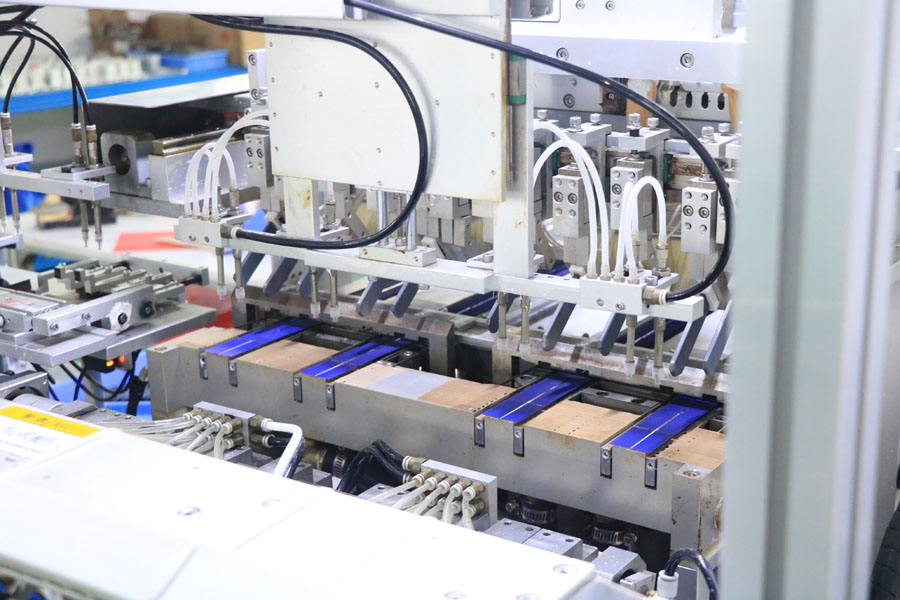
Findy Solar utilize the most advanced and cutting edge technology within the industry, and they have automated solar cell laser cutting machines, automated solar cell stringing machines, solar panel laminators, EL testers, and other professional solar panel testing equipment. This advanced equipment not only improves their production efficiency, it also ensures the consistency of products, and saves a lot of labor costs.

About Us (2).jpg

High efficiency solar cells

  • The core component of a solar panel is the solar cell, which directly affects the electrical performance and stability of the solar panel itself. Therefore, to achieve optimal & maximum efficiency, it is of paramount importance that we only utilize high-quality and the most efficient solar cell configuration. Findy Solar always choose solar cells that are both highly efficient and have superior low-light performance.
  • In addition to using traditional high efficiency crystalline silicon solar cells, they also actively adopt high efficiency back-contact solar cells to meet the specific needs of each of our individual clients.
About Us (3).jpg

Strict quality control

  • Throughout every stage of the production process, starting with the selection of the raw materials, to ending with the finished products Findy Solar employ the stricted quality control measures and procedures within the industry. 
  • They are highly selective and only choose premium quality solar cells, and then they have to pass our stringent testing procedures before assembly. All of their solar panels have to pass a final visual inspection test and our 100% electrical performance test before they are ready for packaging and shipping.
About Us (4).jpg

Excellent customer service

  • Honesty and trustworthiness are their primary operating principles. They are committed to providing clients with the highest quality, and the most efficient solar panels at the most competitive prices.
  • Findy Solar provide their clients with advice, feedback and they offer constant and open communication throughout every stage of the ordering process. 
About Us (5).jpg

Custom Solar Panel, 10W 3V

WSL Solar’s 3V 10W solar panel is built with the latest PERC monocrystalline solar cell. It is laminated by tempered glass, which is durable and robust. This custom solar panel is ideal for use in off grid applications such as solar powered LED lighting, IoT solar, solar traffic sign, small solar powered system etc.

  • Features:
  • – WSL Solar’s 3V 10W solar panel adopts the latest PERC monocrystalline solar cell,  >21% efficiency.
  • – Dimension 345x190x18mm
  • – Laminated by tempered glass, durable & robust
  • – Ideal for use in solar powered LED lighting, IoT solar,solar traffic sign and small solar powered systems etc.
custom solar panel, 10w solar panel
10W Solar Panel

Specification

Item No.WSL-C025
Dimension345x190x18mm
Peak Power (Pmax)10.5W
Voltage at Pmax (Vmp)3.3V
Current at Pmax (Imp)3.182A
Open Circuit Voltage (Voc)3.96V
Short Circuit Current (Isc)3.5A
Cell TypePERC Monocrystalline Solar Cell
Power Tolerance±5%
Encapsulation method3.2mm Tempered glass
Back sheetTPT
Product Warranty5 Years
Lead time25 Days
Storage temperature-20°C ~ 65°C
Working temperature-40°C ~ 85°C
Standard Test Conditions (STC)1000W/m2, 1.5AM, 25°C Cell temperature

Click here to watch the video of this type of custom solar panels. 

View More Custom Solar Panels 5V Solar Panels   |  6V Solar Panels   |  9V Solar Panels

WSL Solar has been a quality and professional manufacturer of custom solar panels and solar solution provider in China since 2006. 
How to Inquire a Custom Solar Panel?

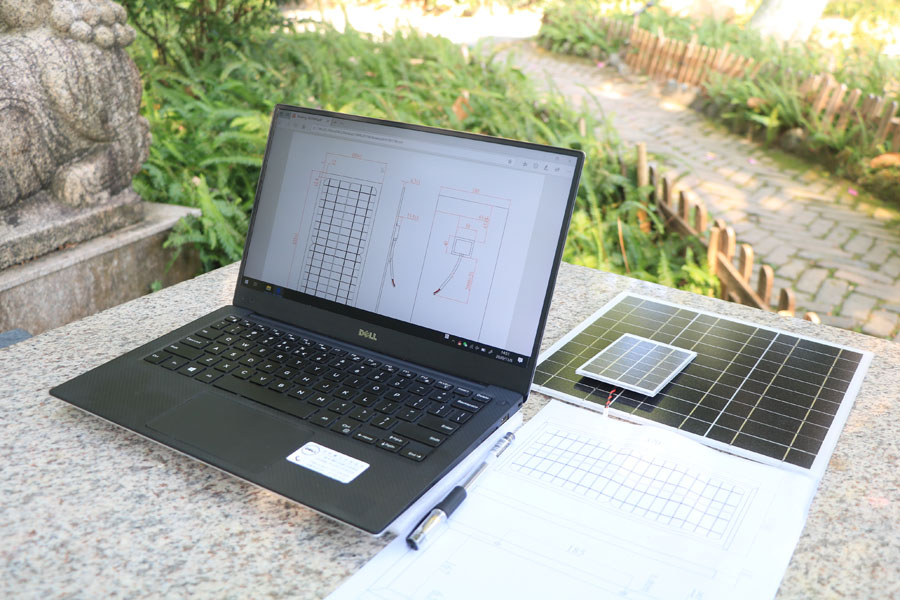
There are different types of custom solar panels: tempered glass solar panel or PET solar panel; mono solar panel or poly solar panel; black solar panel or white solar panel; with frame or not; with junction box or with ribbon only; need wire and terminal or not etc. Do you know how to inquire a custom solar panel? Hope this video could be helpful for you.

How to Inquire a Custom Solar Panel?

"Thirteenth Five-Year" Photovoltaic Development Report Card: Leading the Development of Global Industry

In 2020, the end of the year, the voice from the 2021 National Energy Work Conference is inspiring: the main goals and tasks of the “13th Five-Year Plan” have been successfully completed, and the construction of a clean, low-carbon, safe and efficient energy system has been accelerated. “Four revolutions, one cooperation” the new energy security strategy presents a new situation with deep roots and vitality.

Looking back at the past five years, the progress of China’s energy industry has been amazing: its independent guarantee capacity has always been maintained at more than 80%, and the relationship between supply and demand has continued to improve; the total energy consumption is controlled within 5 billion tons of standard coal, and the average annual growth rate is controlled at 3 % Or less, the economic and social development and the improvement of people’s livelihood and well-being are guaranteed at a relatively low growth rate… The photovoltaic industry has also delivered a brilliant report card.

At the beginning of the “13th Five-Year Plan”, according to the scale development indicators provided by the National Energy Administration, by the end of 2020, the installed capacity of solar power is expected to reach 160 million kilowatts, and the annual power generation will reach 170 billion kWh; The proportion in the structure is about 7%, the proportion in the newly-added power installation structure is about 15%, and the proportion in the national total power generation structure is about 2.5%.

It is worth noting that the country has also put forward clear indicators for solar power technology innovation. For example, the industrial conversion efficiency of monocrystalline silicon cells, polycrystalline silicon cells, and new thin-film solar cells reach 23%, 20%, and 20% respectively.

Leading Custom Solar Panel Manufacturer – WSL Solar 

During the 13th Five-Year Plan, China will deploy the solar power generation industry from four aspects:

1. Fully promote distributed photovoltaic power generation. Promote the comprehensive development and construction of distributed photovoltaic power generation systems in areas with construction conditions such as site, resources, nearby access, and local consumption.

2. Carry out the construction of photovoltaic power stations in an orderly manner. Focus on the western regions with good resource conditions, areas with large-scale access and local consumption capacity, combined with the planning of external transmission channels, orderly construct photovoltaic power station bases to ensure photovoltaic power consumption.

3. Actively promote the construction of solar thermal power stations. Focus on Qinghai, Gansu, Inner Mongolia and other western regions with good solar energy resources and relatively abundant unused land resources and water resources. Actively promote a number of solar thermal power station demonstration projects and build several million kilowatt-level solar thermal power generation demonstration bases.

4. Promote the utilization of solar heat. In 2020, the solar thermal utilization industry will form an industrial pattern of balanced development of manufacturing, system integration, and operation services, and a market layout dominated by civil hot water, heating and cooling, large-scale district heating, industrial and agricultural heating, etc.

During the “Thirteenth Five-Year Plan” period, China’s solar energy industry continued to make breakthroughs, intensively cultivated and innovated, and improved day by day, writing a colorful development picture:

Complete the installation target two years ahead of schedule

During the “Thirteenth Five-Year Plan” period, thanks to the continuous rapid growth of electricity load, the continuous optimization of the construction layout of renewable energy projects, and the continuous strengthening of the assessment of power grid dispatching operation, the installed scale of photovoltaic power generation has been growing rapidly, which has troubled the industry for a long time. The consumption problem of development is gradually alleviating.

According to statistics from the National Energy Administration, by the end of 2017, China’s cumulative installed capacity of photovoltaic power generation was 130 million kilowatts, achieving the “13th Five-Year Plan” guiding target for photovoltaic installation ahead of schedule. As of the end of October 2020, China’s installed photovoltaic power generation capacity has reached 228 million kilowatts, which has more than doubled the goal of the 13th Five-Year Plan. Its newly installed capacity has remained the world’s largest for eight consecutive years, significantly exceeding the industry’s expected.

At the same time, the utilization rate of photovoltaic power generation in China reached 98.3%, a year-on-year increase of 0.2%, an increase of 9% from the end of the “12th Five-Year Plan” period. The consumption situation continued to improve, providing strong support for the promotion of high-quality energy development.

From “two ends outside” to a global leader

According to industry statistics, in 2020, China’s global production capacity for polysilicon, silicon wafers, solar cells and modules will account for 69.0%, 93.7%, 77.7% and 69.2% of the global production capacity, an increase of 7.2% respectively. 4. 2.9, 4.0 and 0.9 percentage points, product production capacity and output ranked first in the world, has become one of the main driving forces for the development of the global photovoltaic industry.

With the rapid growth of installed capacity, the conversion efficiency of solar cells and modules in China’s photovoltaic industry is also constantly updating records. As of the end of 2019, the average conversion efficiency of large-scale mono-polycrystalline cells has increased by about 4 and 3 percentage points respectively compared with 2015. The average conversion efficiency of advanced cells such as heterojunction has reached 23.0%, and a number of technological innovations lead the world Industrial Development. China’s photovoltaic industry has gradually transformed from a world processing base with “two ends outside” to a global photovoltaic development and innovative manufacturing base for the entire industry chain.

In addition, during the “13th Five-Year Plan” period, China’s solar thermal power generation industry has also achieved great development. Since the National Energy Administration announced the first batch of solar thermal power generation demonstration projects in 2016, the development of China’s solar thermal power generation industry has been accelerating. As of the end of 2019, the cumulative installed capacity of 420,000 kilowatts, accounting for 6% of the world, and nearly 300 related enterprises in the industry chain. At the same time, the Delingha 50MW CSP station, one of the first demonstration projects, achieved full-load operation, and its peak shaving depth and speed were significantly better than conventional thermal power plants.

Remarkable results in helping to fight poverty

Since the implementation of photovoltaic poverty alleviation in 2015, the national level has issued five batches of special construction scales or plans for photovoltaic poverty alleviation, and has given special support to photovoltaic poverty alleviation in the management of photovoltaic power generation scale, encouraging local areas to use commercial photovoltaic indicators to build photovoltaic poverty alleviation projects for photovoltaic poverty alleviation Make full preparations for the development planning path of the project.

With the joint efforts of all regions and departments, during the “13th Five-Year Plan” period, photovoltaic poverty alleviation has achieved remarkable results. Up to now, the construction tasks of photovoltaic poverty alleviation projects have been fully completed. A total of 26.36 million kilowatts of photovoltaic poverty alleviation power stations have been built, benefiting 60,000 poor villages and 4.15 million poor households. The annual electricity fee and subsidy income can be about 18 billion yuan. Photovoltaic poverty alleviation has become a new format for poverty-stricken counties to promote industrial poverty alleviation. The important industrial support for the collective economy of poor villages to “break zero” has made important contributions to China’s advancement of the 2020 goal of comprehensive poverty alleviation.

The “14th Five-Year Plan” is approaching, and under the guidance of the “30·60” carbon development goal, the new energy industry represented by the photovoltaic industry will occupy a more important position in China’s energy structure, and provide strong support for accelerating China’s “14th Five-Year Plan” and even longer-term high-quality energy development.

Posted by Carrie Wong | WSL Solar

WSL Solar has been a quality and professional manufacturer of custom solar panel and solar solution provider in China since 2006.
https://www.wsl-solar.com

Original source from https://www.wsl-solar.com/Industry_News/2021/0114/China-Photovoltaic-Development-Report.html