How Solar Cell Laser Cutting Machine Works?

How laser cutting machine works to cut solar cells into small pieces according to your solar panel design?

Cutting solar cells into small pieces is a critical process in solar panel manufacturing, especially for high-efficiency custom solar panels with specific designs. Here’s a detailed breakdown of how laser cutting works for solar cells.

The Core Principle: Controlled-Fracture Cleaving (for Monocrystalline Cells)

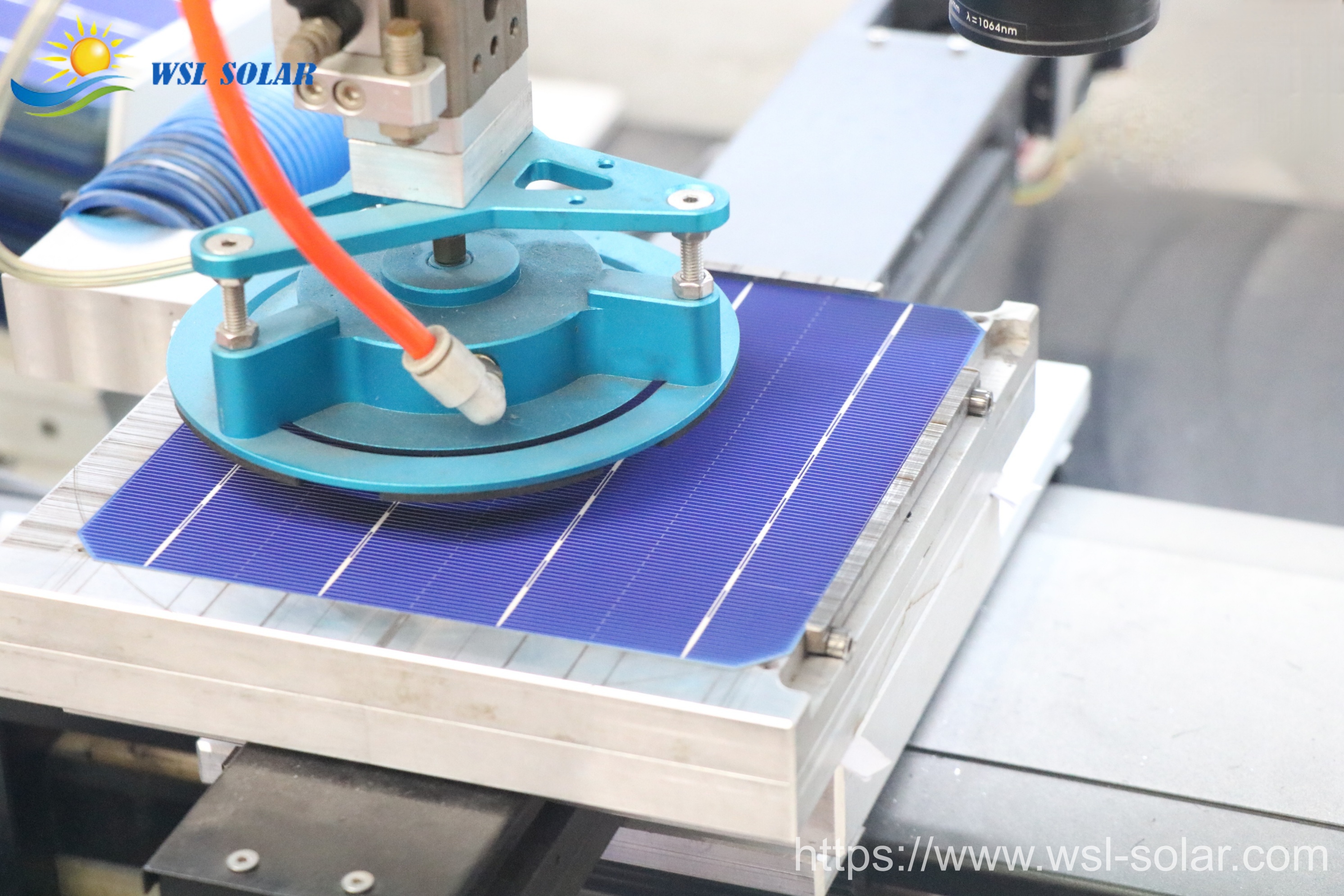
The most common method doesn’t “burn” through the silicon like a traditional laser cutter might with metal. Instead, it uses a highly focused, low-power laser to create a controlled thermal stress that induces a perfectly clean split along the crystal lattice. This is known as “laser scribing and cleaving” or “laser thermal separation.”

Step-by-Step Process

1. Design & Programming

  • Your solar panel design is translated into a cutting path by CAD/CAM software.
  • The software accounts for the wafer’s thickness, material properties, and the required edge quality to minimize electrical losses.

2. Laser Scribing (The Key Step)

  • A short-pulse, low-power infrared (IR) laser is focused to an extremely fine spot on the surface of the silicon wafer.
  • The laser rapidly heats a tiny, localized volume of silicon (to over 1000°C) along the desired cut line.
  • This creates micro-cracks or modifies the material structure along a precise, shallow path (the “scribe line”). The depth is carefully controlled – typically only 10-30% of the wafer’s thickness.
  • Crucially, the laser does NOT vaporize the material. It creates internal stress and a weakened zone.

3. Cleaving / Breaking

  • After scribing, a mechanical breaking step is often used.
  • A controlled bending force applies pressure along the scribe line.
  • Due to the induced stress and the guided micro-cracks, the silicon wafer fractures perfectly along the laser-defined path, following its crystalline structure.
  • This results in a clean, smooth edge with minimal micro-cracks and no thermal damage zone (HAZ) that would reduce cell efficiency.

Why Laser Cutting is Superior for Solar Cells (Compared to Mechanical Saws)

FeatureLaser Scribing & CleavingMechanical Diamond Saw/Scribing
Material Loss (Kerf)Minimal (only the laser scribe line). Saves expensive silicon.Significant (the width of the diamond blade). Wastes material.
Edge QualityVery clean, smooth, low micro-crack depth. Higher mechanical strength.Rougher, more micro-cracks, weaker edges prone to chipping.
Precision & FlexibilityExtremely high. Can cut complex shapes, curves, and very small shingles easily.Low flexibility, typically only straight lines.
Throughput & SpeedVery high speed (meters per second). Non-contact process.Slower, mechanical wear on blades.
Dust & ContaminationAlmost none for the scribing step. Clean process.Generates silicon slurry/dust that must be cleaned, causing contamination.
Thin Wafer HandlingExcellent. The only viable method for wafers <150μm thick without breakage.High breakage rates on very thin wafers.

Critical Requirements for the Laser Process

  • Ultra-Precision: Cutting must be accurate to within microns to ensure cells are identical for automated stringing.
  •  
  • Minimal Heat Affected Zone (HAZ): The laser must not overheat the silicon, as heat creates defects that trap electrons, killing cell efficiency.
  •  
  • Strength Preservation: The cut edge must remain strong to survive the subsequent manufacturing processes (transport, stringing, lamination).
  •  

Summary
In essence, a solar cell laser cutting machine uses a low-power, focused laser to “guide” a fracture through the crystalline silicon, rather than melting its way through. This cold-cutting process maximizes material yield, preserves the electrical quality of the silicon, and enables the intricate cell designs needed for today’s high-efficiency, high-power solar panels. It is an enabling technology for the continuous improvement in solar panel performance and cost-effectiveness.

Posted by Carrie Wong / WSL Solar
WSL Solar has been a quality and professional manufacturer of custom solar panels, solar mini panels, IoT solar panels and solar solution provider in China since 2006.
https://www.wsl-solar.com

Source of origin: https://www.wsl-solar.com/Industry_News/2025/1217/how-solar-cell-laser-cutting-machine-wor.html

What is the Role of EVA in Solar Panels?

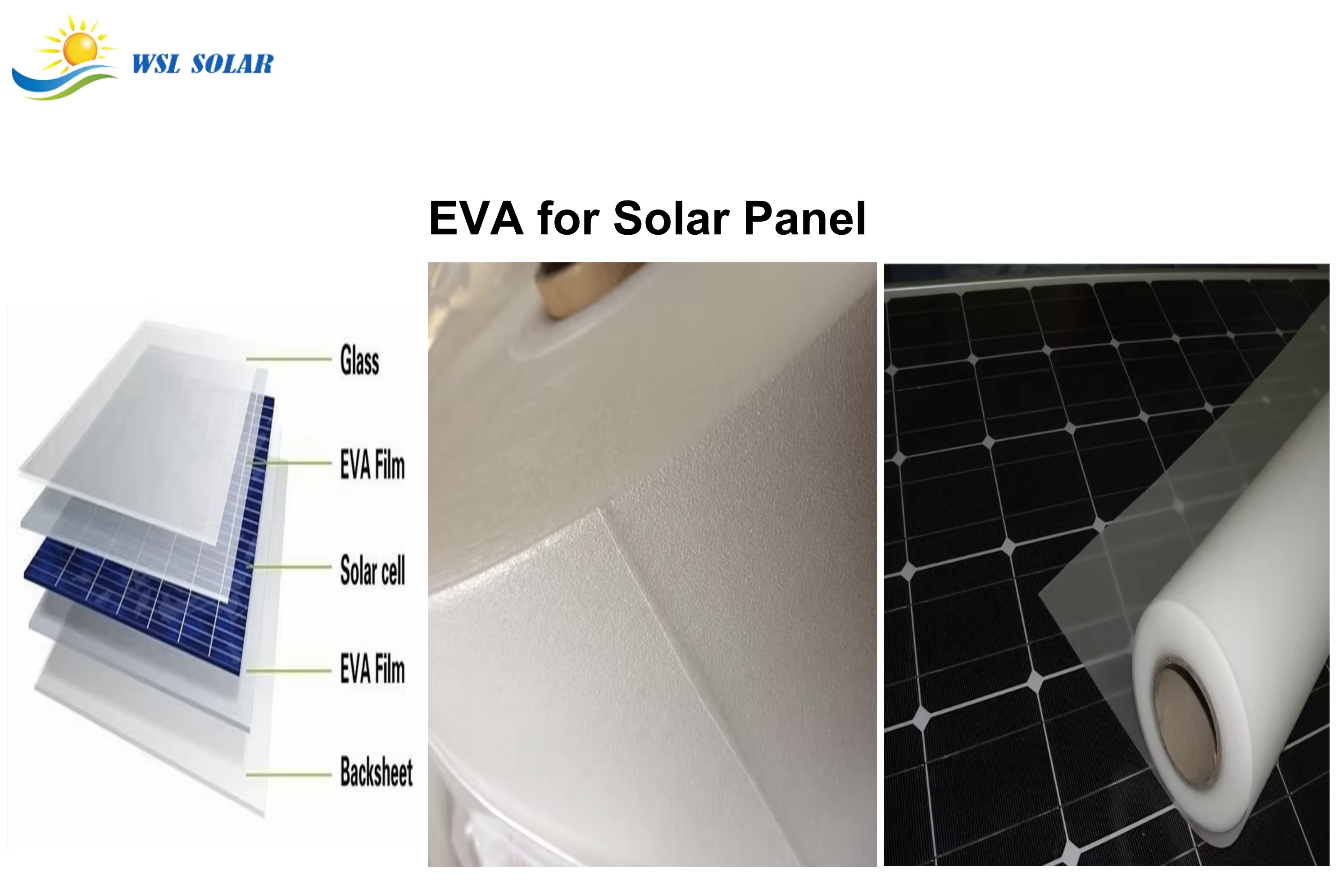
EVA (Ethylene Vinyl Acetate) serves as a protective encapsulant in solar panels, shielding the solar cells from moisture, dust, dirt, and physical damage. It is a transparent, adhesive thermoplastic sheet that holds the solar cells in place between the glass and the backsheet, while also allowing sunlight to pass through to the cells. Its role is crucial for maintaining the solar panel’s efficiency and ensuring its long-term durability and performance. 

Key roles of EVA

  • Protection: EVA acts as a protective barrier against environmental factors like moisture, dirt, and humidity, which can degrade the solar cells over time.
  • Adhesion and support: It provides a strong adhesive bond that holds the solar cells securely between the front glass and the backsheet, preventing them from shifting or becoming damaged.
  • Optical transparency: The film is transparent, allowing sunlight to pass through to the solar cells, which is essential for energy production.
  • Durability: EVA is designed to be durable and has a long lifespan, contributing significantly to the longevity of the solar panel’s performance.
  • Insulation: It helps to insulate the cells and their circuits, which can soften shocks and vibrations. 

How it works

  • During the manufacturing process, solar cells are placed between two sheets of EVA film. The sheets are then heated and laminated, which causes the EVA to become a clear, adhesive, and protective film that seals the cells in place. 

Posted by Carrie Wong / WSL Solar
WSL Solar has been a quality and professional manufacturer of custom solar panels, solar mini panels, IoT solar panels and solar solution provider in China since 2006.
https://www.wsl-solar.com

Source of origin: https://www.wsl-solar.com/Industry_News/2025/1125/what-is-the-role-of-EVA-in-solar-panels.html

What is the Assembly Process of a Custom Solar Panel?

The assembly process of a small, custom solar panel involves preparing the materials, electrically connecting the solar cells, encapsulating them for protection, framing the unit, and performing final testing. 

Materials Needed

  • Solar cells: The core components that convert light into electricity. Monocrystalline or polycrystalline, typically 0.5V each. The number determines the voltage (e.g., 36 cells for an ~18V panel).
  • Encapsulant (EVA film): Ethylene Vinyl Acetate, a clear material that bonds and protects the cells. They become clear when heated.
  • Cover (Tempered glass or clear plastic): Protects the front from weather and impact.
  • Backsheet: A durable polymer layer on the back for insulation and moisture protection.
  • Frame (Aluminum or wood): Provides structural integrity and a mounting point.
  • Tabbing and bus wire: Flat, coated copper wires for electrical connections.
  • Junction box: Houses the electrical connections and bypass diodes.
  • Sealant (Silicone/Epoxy): Used for sealing edges and the junction box to prevent water intrusion.
  • Soldering iron and solder: For making the electrical connections. 

Assembly Steps

  1. Preparation and Template Creation: A template is created to ensure the correct and even placement of the solar cells on a backing board.
  2. Cell Stringing (Connecting Cells): Individual solar cells are connected in series (positive to negative) using tabbing wire and a soldering iron to achieve the desired voltage. The size of the cell determines the amperage, while the number of cells in series determines the voltage.
  3. Laying Up the Panel: The stack of materials is layered in the following order: glass, a layer of EVA film, the interconnected solar cells, a second layer of EVA film, and finally the backsheet.
  4. Bussing Soldering: The strings of cells are connected to each other using a thicker bus wire to form the complete electrical circuit.
  5. Lamination: The layered panel assembly is placed in a laminator (or sealed manually with even pressure and a clear cover) under vacuum and high temperature. This melts the EVA, encapsulating the cells and bonding all the layers together for durability and weather resistance.
  6. Trimming and Framing: Any excess encapsulant material around the edges is trimmed off. The laminated unit is then fitted into a protective aluminum or wooden frame.
  7. Junction Box Installation: A junction box is attached to the back of the panel and the main positive and negative output wires are connected to it. A blocking diode may be included here to prevent current backflow. The box and edges are sealed with silicone or epoxy.
  8. Testing and Quality Control: The finished panel undergoes electrical tests, such as a sun simulator test and an electroluminescence (EL) test, to measure its performance and check for any micro-cracks or defects.
  9. Final Steps: The panel is cleaned, labeled with its specifications, and packaged for use. 

Posted by Carrie Wong / WSL Solar
WSL Solar has been a quality and professional manufacturer of custom solar panels, solar mini panels, IoT solar panels and solar solution provider in China since 2006.
https://www.wsl-solar.com

Manufacturer of Custom Solar Panels – WSL Solar

WSL Solar has been a quality and professional manufacturer of custom solar panels and solar solution provider in China since 2006.

With our in-house R&D team and management team for over 20 years’ experience in solar industry, we can design and develop a customized solar panel in a variety of sizes, shapes and outputs to meet our client’s specific requirement, and provide solution support start from initial product development stage.

Our product categories include tempered glass solar panels, ETFE solar panels, and amorphous solar panels.

Welcome to contact us for high quality custom solar panels.

Email: info@wsl-solar.com

https://www.wsl-solar.com

10V 6W Solar Panel

Key Features:
– Utilize high efficiency mono PERC solar cell,
  up to 23.5% efficiency
– Laminated by tempered glass, rigid, durable
  and long lasting
– Waterproof, scratch resistant, and UV resistant
– Customized solar panels for industrial use

Description:
10V 6W Solar Panel

This 6W solar panel utilizes high efficiency mono PERC solar cells with efficiency up to 23.5%, to ensure its high output. It is laminated by tempered glass to protect the solar cells inside, making it rigid, durable and long lasting. This tailor made solar panel is waterproof, scratch resistant, and UV resistant, specially designed for long term outdoor use in any challenging condition.

Applications:
Tempered glass solar panels are widely used in IoT applications, marine buoys, wireless sensors, traffic warning devise, GPS devices, asset tracking, electric fence chargers, outdoor lighting systems, weather monitoring systems etc.

Solar Panel Specification

Item No.WSL-C042
Solar Panel Size140x250x2mm
Peak Power (Pmax)6W
Voltage at Pmax (Vmp)10V
Current at Pmax (Imp)600mA
Open Circuit Voltage (Voc)12V
Short Circuit Current (Isc)660mA
Solar Cell TypeMono PERC Solar Cell
Power Tolerance±5%
Encapsulation method3.2mm Tempered glass
Back sheetTPT
Product Warranty5 Years
Lead time25 Days
Storage temperature-40°C ~ 85°C
Working temperature-40°C ~ 85°C
Standard Test Conditions (STC)1000W/m2, 1.5AM, 25°C Cell temperature

Click here to watch the video of this type of custom solar panels. 

View More Custom Solar Panels

5V Solar Panels   |  6V Solar Panels   |  9V Solar Panels

WSL Solar has been a quality and professional manufacturer of custom solar panels and solar solution provider in China since 2006. 

The Construction of Tempered Glass Solar Panel and ETFE Solar Panel

Interested in learning about the construction of custom solar panels? Look no further! Here’s a brief introduction to the construction of tempered glass and ETFE solar panels.

For tempered glass solar panels, the construction involves tempered glass, EVA, solar cells, and a backsheet. The photovoltaic glass used must have high light transmittance, and the thickness is either 3.2mm or 2.0mm. EVA is used to bond tempered glass and solar cells, with a thickness ranging from 3mm to 4.5mm. The backsheet’s function is to seal, insulate, and waterproof, and materials such as TPT and TPE are commonly used.

In ETFE solar panels, the construction involves ETFE film, EVA, solar cells, and a PCB. Solar cells are the core parts of solar panels, converting sunlight into electricity via the photovoltaic effect. The power of a solar panel is proportional to the area of the solar cell.

Whether you’re interested in using white or black backsheet, it’s important to choose materials that are resistant to aging. The quality of transparent EVA material directly affects the lifespan of solar panels. By understanding the construction of custom solar panels, you can make informed decisions when choosing the right solar panels for your needs.

Source of origin: https://chinasolar-panel.com/the-construction-of-tempered-glass-and-etfe-solar-panels/

What Is the Photovoltaic Conversion Efficiency of Solar Panels?

The photovoltaic conversion efficiency of solar panels refers to the effective ratio of solar panels to convert received sunlight energy into electrical energy, usually expressed as a percentage (%). It is one of the key indicators for measuring the performance of solar panels.

Calculation formula:

Photovoltaic conversion efficiency = output power (W) \ incident solar power (W) x 100%

– Output power: The maximum power (such as peak power Pmax) generated by the solar panel under standard test conditions (STC).

– Incident solar power: Usually based on the solar irradiance \(1000 W/m 2) under standard test conditions (i.e. “1 sun” intensity).

Key point analysis:

1. Efficiency range:

– Commercial solar panels: The efficiency of mainstream crystalline silicon cells (monocrystalline silicon/polycrystalline silicon) is 15%~24%, and the efficiency of thin-film cells (such as cadmium telluride and copper indium gallium selenide) is about 10%~15%.

– Laboratory technology: For example, the efficiency of perovskite cells and multi-junction stacked cells can exceed 30%, but they have not yet been commercialized on a large scale.

2. Influencing factors:

– Material properties: Different semiconductor materials (such as silicon and gallium arsenide) have different abilities to absorb photons and excite electrons.

– Temperature: Rising temperature will lead to a decrease in efficiency (crystalline silicon cells have an efficiency decrease of 0.3%~0.5% for every 1°C increase in temperature).

– Spectral response: The ability of solar panels to utilize light of different wavelengths (such as ultraviolet light, visible light, and infrared light).

– Optical loss: Surface reflection, glass cover transmittance, etc.

– Electrical losses: resistance losses, shadowing, series/parallel mismatch, etc.

3. Standard Test Conditions (STC):

– Irradiance 1000 W/m2, spectrum AM1.5, temperature 25℃, used to fairly compare the efficiency of different products.

Why is efficiency important?

– Higher efficiency means more power can be generated in the same area, reducing installation costs (such as when roof space is limited).

– But there is a trade-off between efficiency and cost: high-efficiency technologies (such as N-type TOPCon, HJT cells) are usually more expensive, and the cost-effectiveness needs to be considered comprehensively.

Future trends:

– Technology breakthroughs: Perovskite-silicon stacked cells, quantum dot cells, etc. are expected to push efficiency to 30%~40%.

– Cost reduction and efficiency improvement: Optimize existing technologies through processes such as passivated emitter (PERC) and back contact (IBC).

10V 7.5W Custom Solar Panel

Key Features:

– Utilize high efficiency mono PERC solar cell,
  up to 24% efficiency
– Laminated by tempered glass, rigid, durable
   and long lasting
– Waterproof, scratch resistant, and UV resistant
– Customized solar panels for industrial use

Description:
10V 7.5W Solar Panel
 
This 7.5W solar panel utilizes high efficiency mono PERC solar cells with efficiency up to 24%, to ensure its high output. It is laminated by tempered glass to protect the solar cells inside, making it rigid, durable and long lasting. This custom solar panel is waterproof, scratch resistant, and UV resistant, specially designed for long term outdoor use in any challenging condition.
 
Applications:
Tempered glass solar panels are widely used in IoT applications, marine buoys, wireless sensors, traffic warning devise, GPS devices, asset tracking, electric fence chargers, outdoor lighting systems, weather monitoring systems etc.

 Solar Panel Specification

Item No.WSL-C041
Solar Panel Size260x183x15mm
Peak Power (Pmax)7.5W
Voltage at Pmax (Vmp)10V
Current at Pmax (Imp)0.75A
Open Circuit Voltage (Voc)12V
Short Circuit Current (Isc)0.82A
Solar Cell TypeMono PERC Solar Cell
Power Tolerance±5%
Encapsulation method3.2mm Tempered glass
Back sheetTPT
Product Warranty5 Years
Lead time25 Days
Storage temperature-40°C ~ 85°C
Working temperature-40°C ~ 85°C
Standard Test Conditions (STC)1000W/m2, 1.5AM, 25°C Cell temperature

Click here to watch the video of this type of custom solar panels. 

View More Custom Solar Panels

5V Solar Panels   |  6V Solar Panels   |  9V Solar Panels

WSL Solar has been a quality and professional manufacturer of custom solar panels and solar solution provider in China since 2006. 

18V 25W Solar Panel

Key Features:

– Utilize high efficiency mono PERC solar cell, up to   24% efficiency
– Laminated by tempered glass, rigid, durable and long lasting
– Waterproof, scratch resistant, and UV resistant
– Customized solar panels for industrial use

Description:
18V 25W Solar Panel
 
WSL Solar’s 25W solar panel utilizes high efficiency mono PERC solar cells with efficiency up to 24%, to ensure its high output. It is laminated by tempered glass to protect the solar cells inside, making it rigid, durable and long lasting. This custom solar panel is waterproof, scratch resistant, and UV resistant, specially designed for long term outdoor use in any challenging condition.
 
Applications:
Tempered glass solar panels are widely used in IoT applications, marine buoys, wireless sensors, traffic warning devise, GPS devices, asset tracking, electric fence chargers, outdoor lighting systems, weather monitoring systems etc.

Solar Panel Specification

Item No.WSL-C040
Solar Panel Size350x450x25mm
Peak Power (Pmax)27W
Voltage at Pmax (Vmp)13.4V
Current at Pmax (Imp)2.01A
Open Circuit Voltage (Voc)16V
Short Circuit Current (Isc)2.13A
Solar Cell TypeMono PERC Solar Cell
Power Tolerance±5%
Encapsulation method3.2mm Tempered glass
Back sheetTPT
Product Warranty5 Years
Lead time25 Days
Storage temperature-40°C ~ 85°C
Working temperature-40°C ~ 85°C
Standard Test Conditions (STC)1000W/m2, 1.5AM, 25°C Cell temperature

WSL Solar has been a quality and professional manufacturer of custom solar panels, solar mini panels, IoT solar panels and solar solution provider in China since 2006.

https://www.wsl-solar.com

What Are the Applications of Amorphous Solar Cells?

Amorphous silicon (a-Si, Amorphous Silicon) solar cells are a kind of thin film solar cells. Compared with traditional crystalline silicon (monocrystalline/polycrystalline) cells, it has good weak light performance, low cost, and flexibility, but the conversion efficiency is low (about 5%-10%). The following are its main application areas:

1. Consumer electronics & portable devices
– Solar calculators and electronic watches: The most common application in the early days, using the characteristics of amorphous silicon that can still generate electricity in weak light indoors.
– Power bank/solar backpack: Flexible amorphous silicon film can be integrated into portable devices to power low-power devices such as mobile phones.
– Wireless keyboard/mouse: Some low-power electronic products use amorphous silicon cells as auxiliary power sources.

2. Building integrated photovoltaics (BIPV)
– Photovoltaic glass curtain wall: Amorphous silicon film can be made into semi-transparent or colored components for building facades, taking into account both power generation and aesthetics.
– Solar awnings/skylights: Flexible or lightweight design, suitable for curved or special-shaped building structures.
– Rooftop solar tiles: Combined with building materials, suitable for low-load bearing or special-shaped roofs.

3. Outdoor & Emergency Power Supply
– Solar camping lights/garden lights: Taking advantage of weak light power generation, suitable for outdoor scenes with unstable lighting.
– Emergency charging equipment: Such as temporary power supply for disaster relief and power supply for field monitoring equipment.
– Solar traffic signs: Provide energy for low-power LED indicator lights.

4. Flexible & Wearable Devices
– Flexible solar panels: Used for curved installation scenarios such as tents, car roofs, and sails.
– Wearable devices: Such as solar hats and clothes, powering smart watches or sensors (but with lower power).

5. Agriculture & Internet of Things (IoT)
– Agricultural sensor power supply: Such as soil moisture monitoring, weather stations and other low-power devices.
– Remote monitoring equipment: off-grid applications such as forest fire prevention cameras and wireless communication relay stations.

6. Special environment applications
– Aerospace: Some early satellites used amorphous silicon batteries (now mostly replaced by high-efficiency batteries such as GaAs).
– High temperature environment: Amorphous silicon has a good temperature coefficient and has less performance degradation in high temperature environments.

Advantages and Disadvantages of Amorphous Silicon Cells

AdvantagesAdvantages
Good performance in weak light (usable on cloudy days/indoors)Low conversion efficiency (5%-10%)
Low manufacturing costPhotodegradation effect (faster initial efficiency drop)
Can be made into flexible/translucent componentsShort life (about 10-15 years, lower than crystalline silicon)
Good high temperature performanceLow power density, large footprint

Future Trends
Although amorphous silicon cells are not as efficient as crystalline silicon or emerging perovskite cells, their low cost, weak light adaptability, and flexibility still allow them to maintain a certain market in BIPV, Internet of Things, consumer electronics and other fields. In the future, efficiency may be improved through layering technology (such as stacking with amorphous silicon/microcrystalline silicon) or combining with perovskite.

Posted by Carrie Wong / WSL Solar

WSL Solar has been a quality and professional manufacturer of custom solar panels, solar mini panels, IoT solar panels and solar solution provider in China since 2006.

https://www.wsl-solar.com