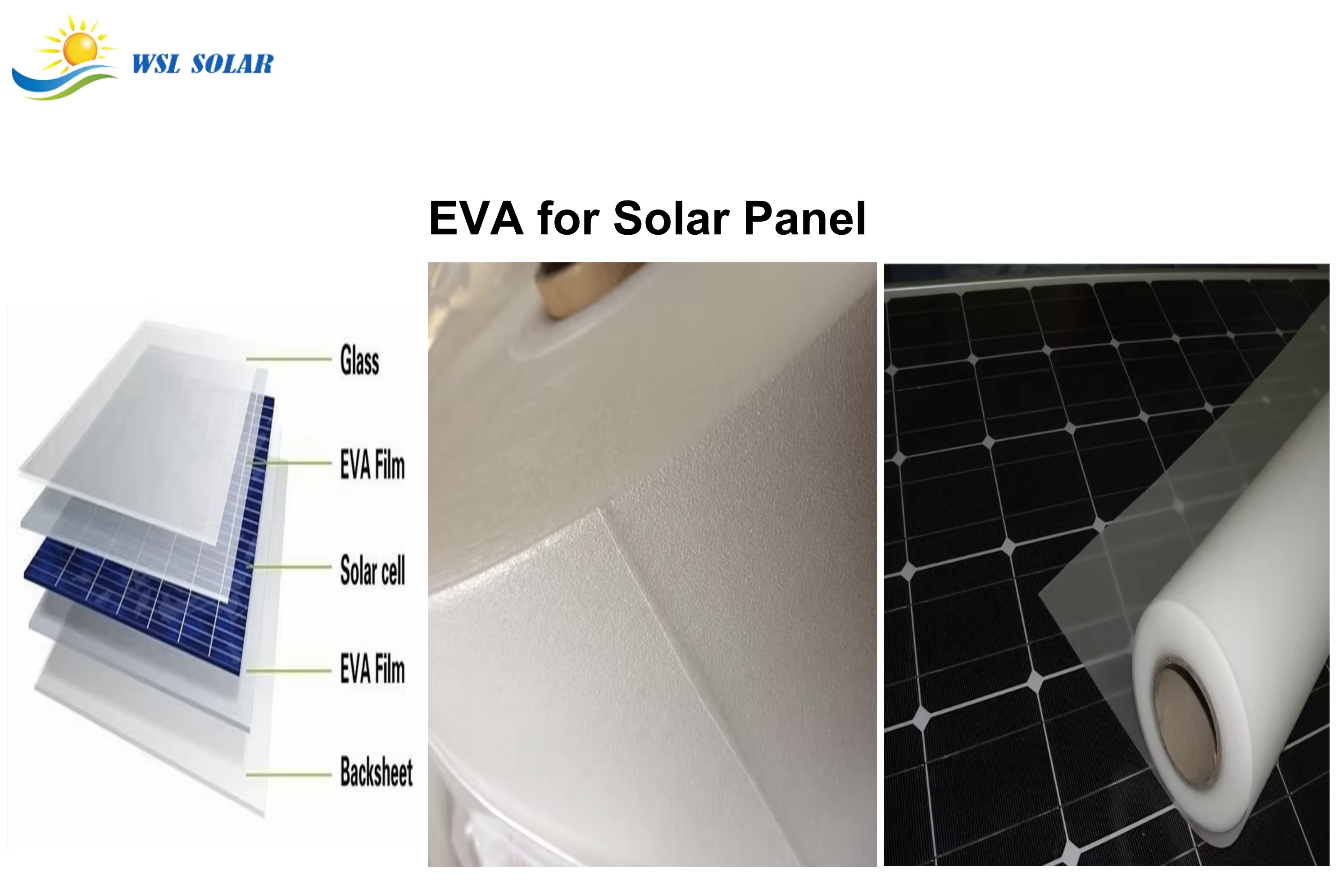
EVA (Ethylene Vinyl Acetate) serves as a protective encapsulant in solar panels, shielding the solar cells from moisture, dust, dirt, and physical damage. It is a transparent, adhesive thermoplastic sheet that holds the solar cells in place between the glass and the backsheet, while also allowing sunlight to pass through to the cells. Its role is crucial for maintaining the solar panel’s efficiency and ensuring its long-term durability and performance.
Key roles of EVA
Protection: EVA acts as a protective barrier against environmental factors like moisture, dirt, and humidity, which can degrade the solar cells over time.
Adhesion and support: It provides a strong adhesive bond that holds the solar cells securely between the front glass and the backsheet, preventing them from shifting or becoming damaged.
Optical transparency: The film is transparent, allowing sunlight to pass through to the solar cells, which is essential for energy production.
Durability: EVA is designed to be durable and has a long lifespan, contributing significantly to the longevity of the solar panel’s performance.
Insulation: It helps to insulate the cells and their circuits, which can soften shocks and vibrations.
How it works
During the manufacturing process, solar cells are placed between two sheets of EVA film. The sheets are then heated and laminated, which causes the EVA to become a clear, adhesive, and protective film that seals the cells in place.
Posted by Carrie Wong / WSL Solar WSL Solar has been a quality and professional manufacturer of custom solar panels, solar mini panels, IoT solar panels and solar solution provider in China since 2006. https://www.wsl-solar.com
The assembly process of a small, custom solar panel involves preparing the materials, electrically connecting the solar cells, encapsulating them for protection, framing the unit, and performing final testing.
Materials Needed
Solar cells: The core components that convert light into electricity. Monocrystalline or polycrystalline, typically 0.5V each. The number determines the voltage (e.g., 36 cells for an ~18V panel).
Encapsulant (EVA film): Ethylene Vinyl Acetate, a clear material that bonds and protects the cells. They become clear when heated.
Cover (Tempered glass or clear plastic): Protects the front from weather and impact.
Backsheet: A durable polymer layer on the back for insulation and moisture protection.
Frame (Aluminum or wood): Provides structural integrity and a mounting point.
Tabbing and bus wire: Flat, coated copper wires for electrical connections.
Junction box: Houses the electrical connections and bypass diodes.
Sealant (Silicone/Epoxy): Used for sealing edges and the junction box to prevent water intrusion.
Soldering iron and solder: For making the electrical connections.
Assembly Steps
Preparation and Template Creation: A template is created to ensure the correct and even placement of the solar cells on a backing board.
Cell Stringing (Connecting Cells): Individual solar cells are connected in series (positive to negative) using tabbing wire and a soldering iron to achieve the desired voltage. The size of the cell determines the amperage, while the number of cells in series determines the voltage.
Laying Up the Panel: The stack of materials is layered in the following order: glass, a layer of EVA film, the interconnected solar cells, a second layer of EVA film, and finally the backsheet.
Bussing Soldering: The strings of cells are connected to each other using a thicker bus wire to form the complete electrical circuit.
Lamination: The layered panel assembly is placed in a laminator (or sealed manually with even pressure and a clear cover) under vacuum and high temperature. This melts the EVA, encapsulating the cells and bonding all the layers together for durability and weather resistance.
Trimming and Framing: Any excess encapsulant material around the edges is trimmed off. The laminated unit is then fitted into a protective aluminum or wooden frame.
Junction Box Installation: A junction box is attached to the back of the panel and the main positive and negative output wires are connected to it. A blocking diode may be included here to prevent current backflow. The box and edges are sealed with silicone or epoxy.
Testing and Quality Control: The finished panel undergoes electrical tests, such as a sun simulator test and an electroluminescence (EL) test, to measure its performance and check for any micro-cracks or defects.
Final Steps: The panel is cleaned, labeled with its specifications, and packaged for use.
Posted by Carrie Wong / WSL Solar WSL Solar has been a quality and professional manufacturer of custom solar panels, solar mini panels, IoT solar panels and solar solution provider in China since 2006. https://www.wsl-solar.com
12BB (12 busbar) solar cells use multi-busbar (MBB) technology to collect electricity from the solar cell, which increases efficiency and power output compared to traditional designs with fewer busbars. The increased number of busbars shortens the electrical path, which reduces resistance and power loss. This also enhances reliability, making the cells more resistant to cracking and better at performing in low-light conditions.
1. The Core Concept: What are Busbars (BB)? A standard solar cell generates electricity when sunlight hits it. This electricity needs to be collected and channeled out of the cell. This is the job of the fingers and the busbars.
Fingers: The very fine, hair-thin lines that cover the cell. They collect the electricity.
Busbars (BBs): The wider, more prominent lines that run perpendicular to the fingers. They act as the main “highways” that gather the current from all the fingers and transport it to the tabbing wires, which connect the cells together in a module.
So, a 12BB cell simply has 12 of these main silver highways on its surface.
2. The Evolution: From 2BB to 5BB, 9BB, 12BB, and Beyond The number of busbars has been steadily increasing over the years as manufacturing technology has advanced.
2BB to 5BB: This was the standard for a long time. Fewer, thicker busbars were easier to manufacture.
9BB, 12BB, 15BB, etc.: The current industry trend is to move to more, but thinner and finer, busbars.
3. Key Advantages of 12BB Solar Cells Why is moving to more busbars beneficial? The primary goals are higher efficiency and increased reliability. 1). Higher Efficiency & Power Output
Reduced Electrical Resistance: Electricity has to travel a shorter distance from where it’s generated to the nearest busbar. Shorter travel paths mean less energy is lost as heat (a phenomenon called resistive loss).
Better Current Collection: With more collection points, the cell can collect current more uniformly and effectively, especially in low-light conditions.
Reduced Shading: Although there are more busbars, each one is made much thinner. The total amount of area on the cell covered by silver (which blocks sunlight) is reduced. This means more active silicon area is exposed to light.
2). Improved Reliability and Durability
Lower Mechanical Stress: The tabbing wires (ribbons) that connect the cells are also made thinner. Thinner ribbons are more flexible, which reduces the stress on the cell during thermal expansion and contraction (from daily heating/cooling cycles). This lowers the risk of micro-cracks.
Better Performance with Micro-Cracks: If a micro-crack does occur, it is less likely to completely isolate a section of the cell because there are more busbars providing alternative paths for the current to flow. This helps maintain the module’s power output over its lifetime.
3). Cost-Effectiveness
While using 12 busbars requires more precise manufacturing, it often uses less silver overall. Silver is a significant cost driver in solar cell production. By using finer lines, manufacturers save on material costs while boosting performance.
4. Comparison Table: BB Evolution
Feature
Traditional (e.g., 5BB)
Advanced (12BB)
Benefit of 12BB
Number of Busbars
Fewer (e.g., 5)
More (12)
Shorter current path, less resistance
Busbar Width
Thicker
Thinner & Finer
Less shading, more light capture
Tabbing Ribbon
Thicker
Thinner & More Flexible
Reduced risk of micro-cracks
Efficiency
Lower
Higher
More power from the same size cell/roof
Reliability
Standard
Improved
Better long-term performance and durability
Conclusion
12BB solar cells represent a key incremental innovation in photovoltaic technology. They are not a fundamentally new type of cell (like PERC or HJT), but rather an optimization of the electrical grid design on mainstream cell types.
This design shift is a major reason why the power ratings of solar panels have been steadily increasing over the past few years, with many premium residential and commercial panels now utilizing 12BB or even higher busbar count cells (like 16BB) to achieve higher efficiencies and better reliability.
In short: 12BB cells are a more refined, efficient, and robust version of the standard silicon solar cell, leading to better-performing and longer-lasting solar panels.
Posted by Carrie Wong / WSL Solar WSL Solar has been a quality and professional manufacturer of custom solar panels, solar mini panels, IoT solar panels and solar solution provider in China since 2006. https://www.wsl-solar.com
WSL Solar has been a quality and professional manufacturer of custom solar panels and solar solution provider in China since 2006.
With our in-house R&D team and management team for over 20 years’ experience in solar industry, we can design and develop a customized solar panel in a variety of sizes, shapes and outputs to meet our client’s specific requirement, and provide solution support start from initial product development stage.
Our product categories include tempered glass solar panels, ETFE solar panels, and amorphous solar panels.
Welcome to contact us for high quality custom solar panels.
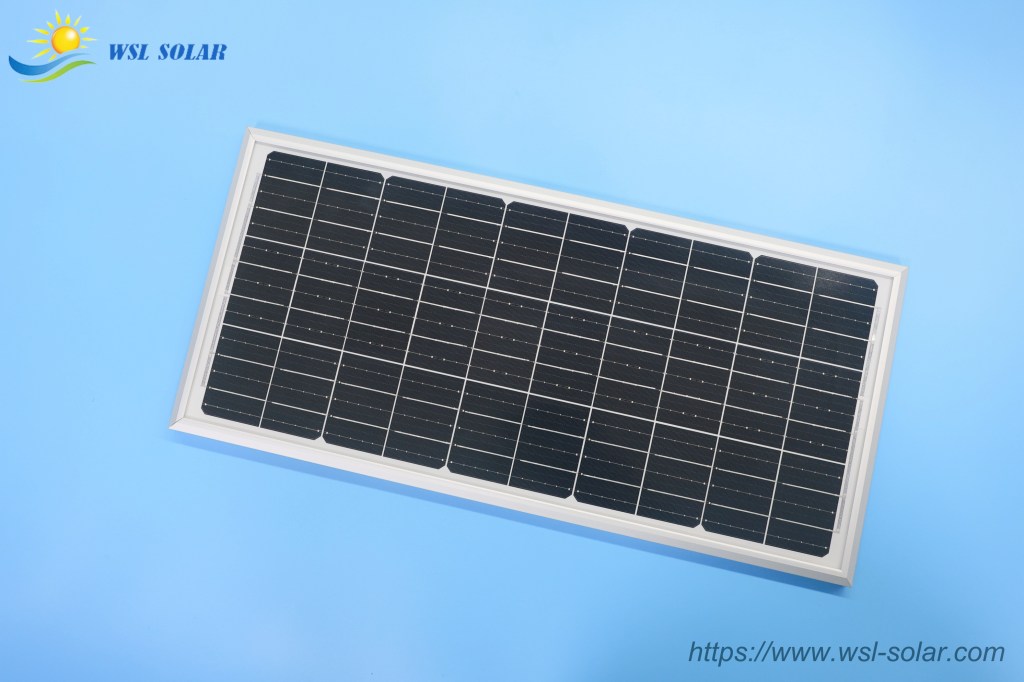
 Custom Solar Panel